

Grant compliance has become one of the most significant emerging risk areas for nonprofit organizations. Securing funding is a challenge in itself, but managing that funding now demands more rigorous reporting and closer scrutiny from federal agencies, state pass-through entities, and other funders.
In a recent webinar, Navigating Grant Compliance: A Growing Risk Area for Nonprofits, Grassi Nonprofit Practice Leader and Partner David M. Rottkamp and Nonprofit Advisory Leader and Partner Bryan Fryer discussed how nonprofits can implement strong controls, identify compliance risks early, and maintain clear communication with internal teams and government funders.
Drawn from experience working with hundreds of organizations across the sector, the five priorities below span leadership, program management, funder communication and organizational culture.
Grant Compliance Protects More Than Funding
Grant compliance is not only about keeping funding in hand. In protecting the grant, an organization also protects valuable cash flow, resources, time, and reputation.
This is why a grant should not be viewed simply as revenue, but as an asset that signifies the organization’s capacity to deliver services, maintains credibility with funders, and secure funding in the future.
Under 2 CFR Part 200 (Uniform Guidance), that responsibility begins with the first federal dollar of funding received. The five priorities below apply to any nonprofit managing grant funding, regardless of its size.
1. Build Internal Controls That Protect the Grant as an Asset
Internal controls are the organization’s first line of defense against noncompliance and demonstrate that funds were managed properly during an audit.
The COSO framework, developed by the Committee of Sponsoring Organizations, provides a useful structure for grant oversight in several key areas:
- Control environment: Leadership, from the CEO, executive director, and board, sets the tone for accountability that carries through the organization.
- Risk assessment: The organization identifies where grant-specific risks regarding eligibility, allowability, and reporting may occur and addresses them proactively.
- Control activities: Approvals, reconciliations, and segregation of duties are performed consistently, rather than being treated as a box to check.
- Information and communication: Finance and program staff share timely and accurate information to stay aligned.
- Monitoring: Grant activity is reviewed regularly, with issues addressed before they escalate into findings.
Segregation of duties is critically important to this framework, and one of the more difficult controls for a lean organization to maintain. Smaller organizations may consider implementing compensating controls, such as having the board treasurer review bank statements or requiring a second signature on payments above a certain amount.
2. Treat Documentation as Part of the Compliance Process
Documentation must be comprehensive, consistent, and easy to access. This is essential not just for funders and auditors but also for the internal teams managing the grant daily.
For organizations handling multiple grants, keep documentation clear across:
- Financial records: Including the general ledger by grant, invoices, receipts, payroll support, bank reconciliations and budget-to-actual reporting
- Program records: Including service delivery logs, participant eligibility files, outcomes data, subcontractor deliverables, where applicable, and related program support
- Administrative records: Including signed grant agreements, amendments, procurement files, conflict of interest disclosures and correspondence with the funder
- Personnel costs: Time reflecting actual work rather than budget estimates, with allocations across awards totaling 100%
- Funder communication: Kept with the grant file; verbal guidance should be confirmed in writing
3. Know the Most Common Audit Risks and Design Around Them
In Grassi’s work advising nonprofit clients across the sector, the most common risk areas, as well as typical root causes and actionable prevention strategies include the following:
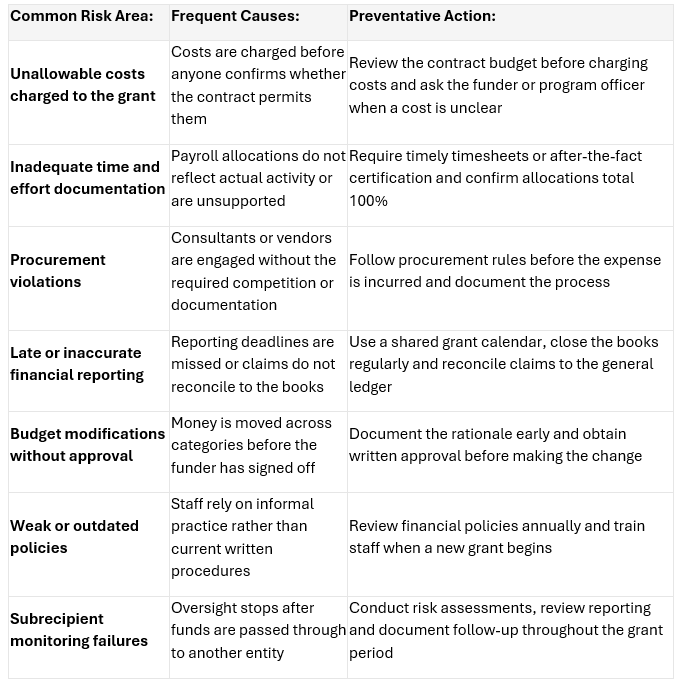
The value in knowing and understanding these risks lies not simply in awareness, but in the ability to build processes around them before they become problems.
If an audit finding does occur, voluntary self-disclosure generally puts the organization in a stronger position than waiting for the problem to surface during an audit or review. The communication should be direct, factual and solution-oriented. Funders want to support organizations that understand their obligations and address issues responsibly.
4. Strengthen Coordination Between Finance and Program Teams
Many compliance failures begin as communication failures. Finance and program teams may each be doing their jobs, but not from the same set of facts.
Organizations that manage this communication well create a regular operating rhythm between finance and program staff. Practically, this means:
- Holding regular grant check-ins
- Maintaining a shared calendar with all reporting and claiming deadlines
- Reviewing the grant budget jointly when awarded
- Clarifying roles around financial reporting, narratives, time allocation and issue escalation
When those channels are in place, risks are easier to spot early. Over time, they also reinforce a broader culture of compliance across the organization.
5. Manage Funder Relationships Proactively and Support a Culture of Compliance
Strong funder relationships are built through clear expectations, timely communication and consistent follow-through.
A proactive approach includes:
- Introducing key finance and program contacts early in the grant period
- Confirming reporting deadlines and submission expectations upfront
- Asking for clarification before charging uncertain costs or making changes
Strong Grant Compliance Starts With Leadership
Grant compliance does not sit with finance alone. It is an organization-wide discipline that starts with leadership, carries through program and finance operations and depends on clear accountability across the life of the award.
Organizations that build that discipline into their operating rhythm are better positioned to protect cash flow, maintain credibility with funders and keep their focus where it belongs: on mission delivery.
For More Resources on Grant Compliance:
- 2 CFR Part 200 – Uniform Guidance: The federal framework governing allowability, allocability, procurement, documentation and reporting for grant funding.
- Single Audit Requirements Overview: A summary of current single audit requirements, including the expenditure threshold and related compliance considerations.
- Navigating Grant Compliance: A Growing Risk Area for Nonprofits: Grassi’s webinar covering internal controls, documentation, audit findings and funder communication.
- Grassi Grant Compliance Services: Learn how Grassi helps nonprofits strengthen compliance processes, improve oversight and manage grant-related risk.
Assess Your Grant Compliance Approach
For organizations managing federal or pass-through funding, Grassi’s nonprofit advisors can help strengthen grant oversight, improve day-to-day compliance practices and build a culture of compliance at every level of the organization, protecting both funding and reputation. To discuss your organization’s grant compliance approach, connect with a Grassi advisor today.
